

A Power BI retail dashboard built pro bono on a real business's anonymized sales data.
We wanted a portfolio piece built on real data, not a tidy sample dataset. A retail business agreed to let us build on its sales, inventory, and customer records, so Figment Forge shows what a small retailer can see when that data lives in one place, backed by a proper data pipeline.
We consolidated the business's sales, inventory, and customer data into a single pipeline, built ML forecasting models in Python, and brought everything together in an interactive Power BI dashboard.
The result: six purpose-built dashboard pages covering sales performance, brand analysis, customer segmentation, inventory health, trend forecasting, and an executive summary, all built on over $1M in revenue across 100K+ orders.
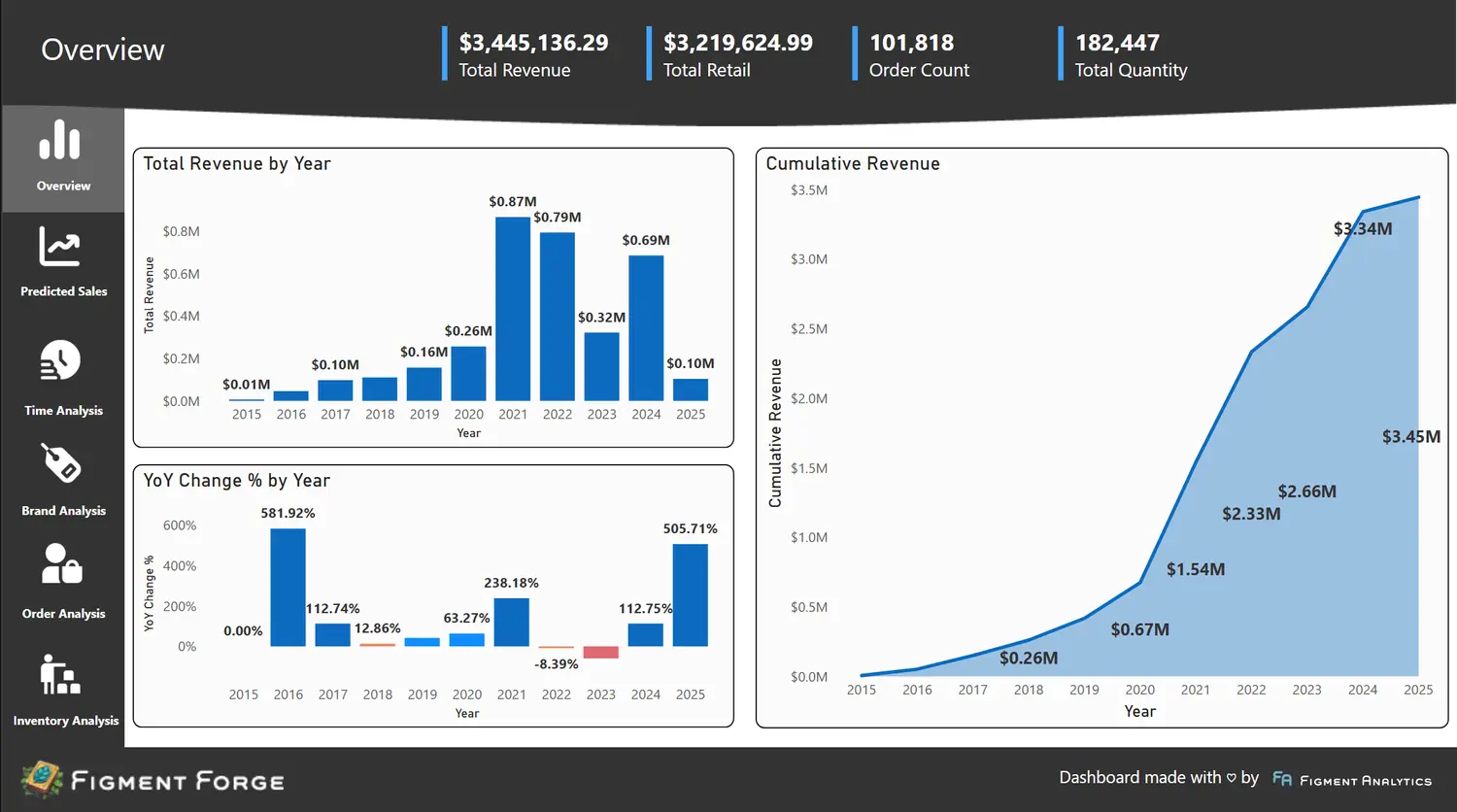
Machine learning models that project future sales trends to support inventory and marketing planning.
Historical performance tracking across multiple dimensions, surfacing seasonal patterns and growth trajectories.
Side-by-side brand analytics showing which product lines drive revenue and which underperform.
Data-driven customer groupings that support targeted marketing and retention planning.
Stock levels tied to sales velocity, built to flag overstock and stockout risk.
A complete analytics suite covering sales, customers, products, trends, forecasts, and executive summary views.
Real data meant real responsibility. The business agreed to this public showcase, and before anything was published we anonymized it: dollar amounts were randomized within realistic ranges, and product names were replaced with invented ones.
The patterns, scale, and structure are true to the original data. The specific numbers and products you see are not. We treat every dataset a client shares with us the same way: it stays theirs.
Interact with the live dashboard below. Figures and product names have been altered to protect the business.
Read how we built it on our blog for a deeper look at how the dashboard was designed and the decisions behind it. You can also explore our LA 311 Dashboard and SurfUp projects for more examples of how we turn raw data into interactive analytics.
Our Dashboard Sprint builds one working dashboard on your data in ten business days, for a fixed $6,500. Book a free 30-minute call and we'll map out what yours could look like.
or email us directly at mazen@figmentanalytics.com